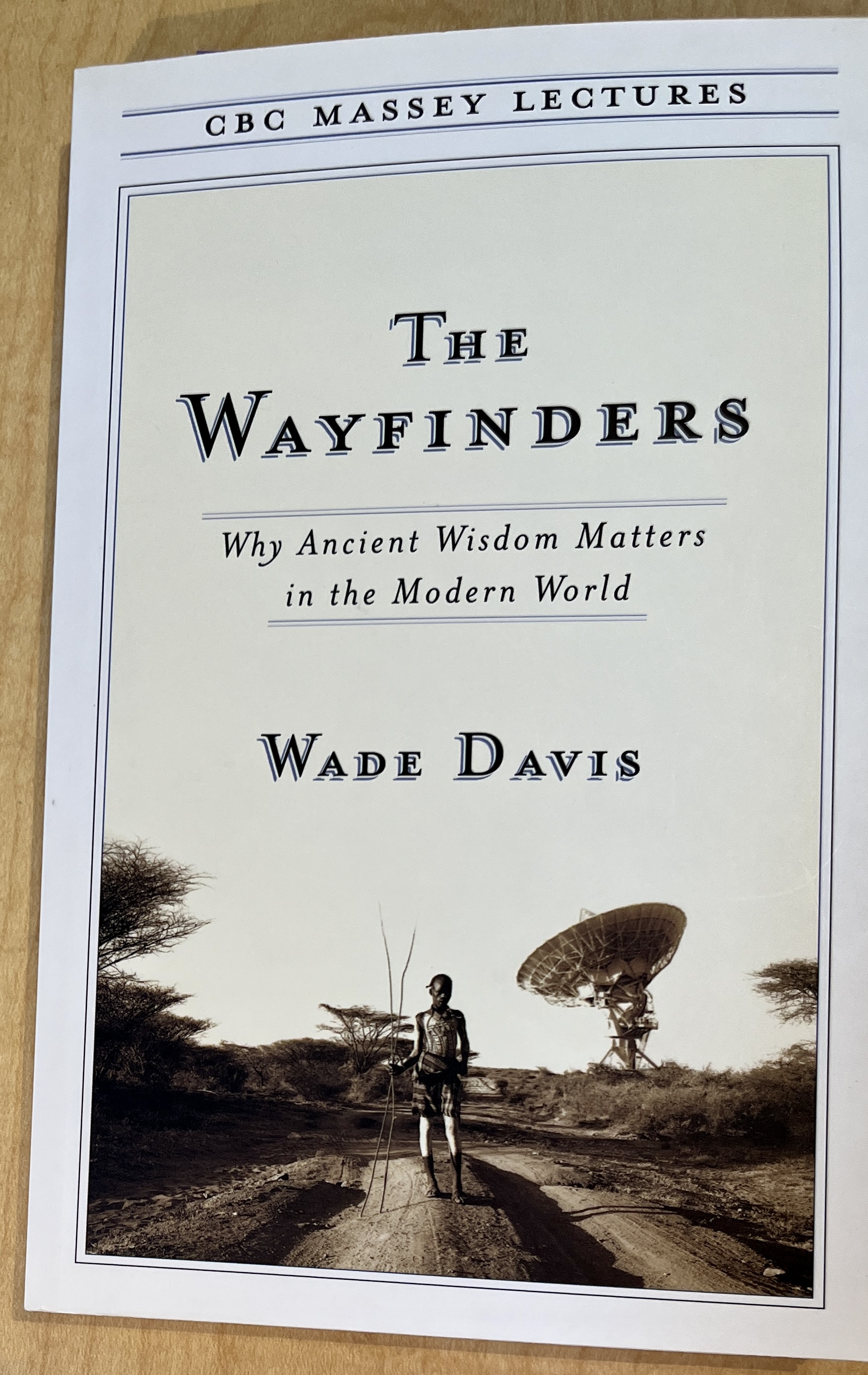
 The Wayfinders, by Wade Davis. Pub 2009
I’ve had this book for many years, likely not long after it was published. I recall reading a few previous books in the series – especially Payback (Margaret Atwood) and A Short History of Progress (Ronald Wright) – and purchasing this one when it came out. After starting it, I think I ran out of steam for social and cultural awareness. Then, a few days ago, I got an invitation to a lecture by Wade Davis at an upcoming event and it seemed like a sign of some kind to finally finish reading this one.
The book is the compilation of the five Massey Lectures that Davis delivered in 2009. The lectures/essays present his experiences and travels throughout Polynesia and Southeast Asia, the Arctic, Africa, Australia, and South America, exploring the small and disappearing cultures of the various parts of the world. The lectures argue that these cultures, despite being small and marginal, offer value and wisdom to the rest of us. Just because they appear “stalled” in their development, with limited material goods and creature comforts, does not make them less “advanced”, just different. In documenting these cultures, he also shines a light on their destroyers – Western colonial explorers whose, “response to cultures we encounter but do not understand, whose profound complexities are so dazzling as to overwhelm” was to assume them to be naive or backward, in need of civilization.
The wayfinders or navigators of the title are those individuals within the cultures who learn to find ways across vast territories and spaces without modern technology. The most remarkable examples are the wayfinders of Polynesia, who could navigate across much of the Pacific Ocean long before (and often better than) those equipped with maps, compasses, sextants, and chronometers. The long-expressed doubt that these peoples could have populated all of region the stretching south and east from Asia, including Australia, Hawaii, and New Zealand, was primarily a reflection of the hubris of Western culture: if we couldn’t do it, how they possibly have managed it? But manage it they did, and along the way developed unique cultures and livelihoods that were connected and integrated with the earth and the sea.
One of the many thoughts provoked for me in this book is the role or significance of traditions in sustaining a culture, and how removing or changing something, however small, can have a catastrophic effect. We can read about the major devastations – nomadic peoples forced to become stationery or even urban; the desecration and obliteration of languages – but these often start as something small like a change in a ritual or a costume or social hierarchy. Such cultural erosion, with its disruptions in the balance of families or social systems and their links to the land, can lead to similar devastations over generations. Perhaps then even Western traditions and religions are worthy of some respect and reinforcement.
Another important message is the role of place in the development and sustainment of culture. The culture and ways of the Inuit would be at best impractical in Australia. The seafaring ways of the Marquesans would make no sense in the upper Amazon or on the edges of the Sahara. As such, the notion of a universal culture (just like a universal language) sounds appealing until you consider that it doesn’t fit everywhere.
No culture is perfect, not least our self-satisfied Western ones. Davis does a good take down of these, noting that while there are many criteria by which it is excellent, also states, “if the criteria of excellence shifted, for example, to the capacity to thrive in a truly sustainable manner, with a true reverence and appreciation for the earth, the Western paradigm would fail.” Davis also takes down the notion of a saviour or of a small group that can fix it all for everyone everywhere, that can engineer culture and society for the better. Citing despots and dictators from past and recent history, he notes that their efforts, “would appear laughably naive had not the consequences proved so disastrous for so much of humanity.” He goes on to quote Peter Matthiessen: “Anyone who thinks they alone can change the world is both wrong and dangerous.” (I’m looking at you, WEF, Bill Gates, Elon Musk.)
In considering now the changing world, the literally shifting landscapes and shorelines, being able to learn from those cultures that are more in tune with the earth may be essential for humanity’s survival. Those who live in and with the land, who can read it in ways that science cannot, may hold the keys to how mankind survives changing climate. After all, the indigenous peoples of the world lived through it before and survived and thrived. Even without the internet.
Fate: I’m keeping this one and all my highlights and notes, and I’ll likely dig out and/or get more of these Massey Lecture books.
10 – essays
12 – a book I should read
13 – set places I’ve never been
25 – a new author to me
26 – science
29 – a leftover
31 – history/politics
33 – Canadian author
36 – part of a series
 rclr
rclr 