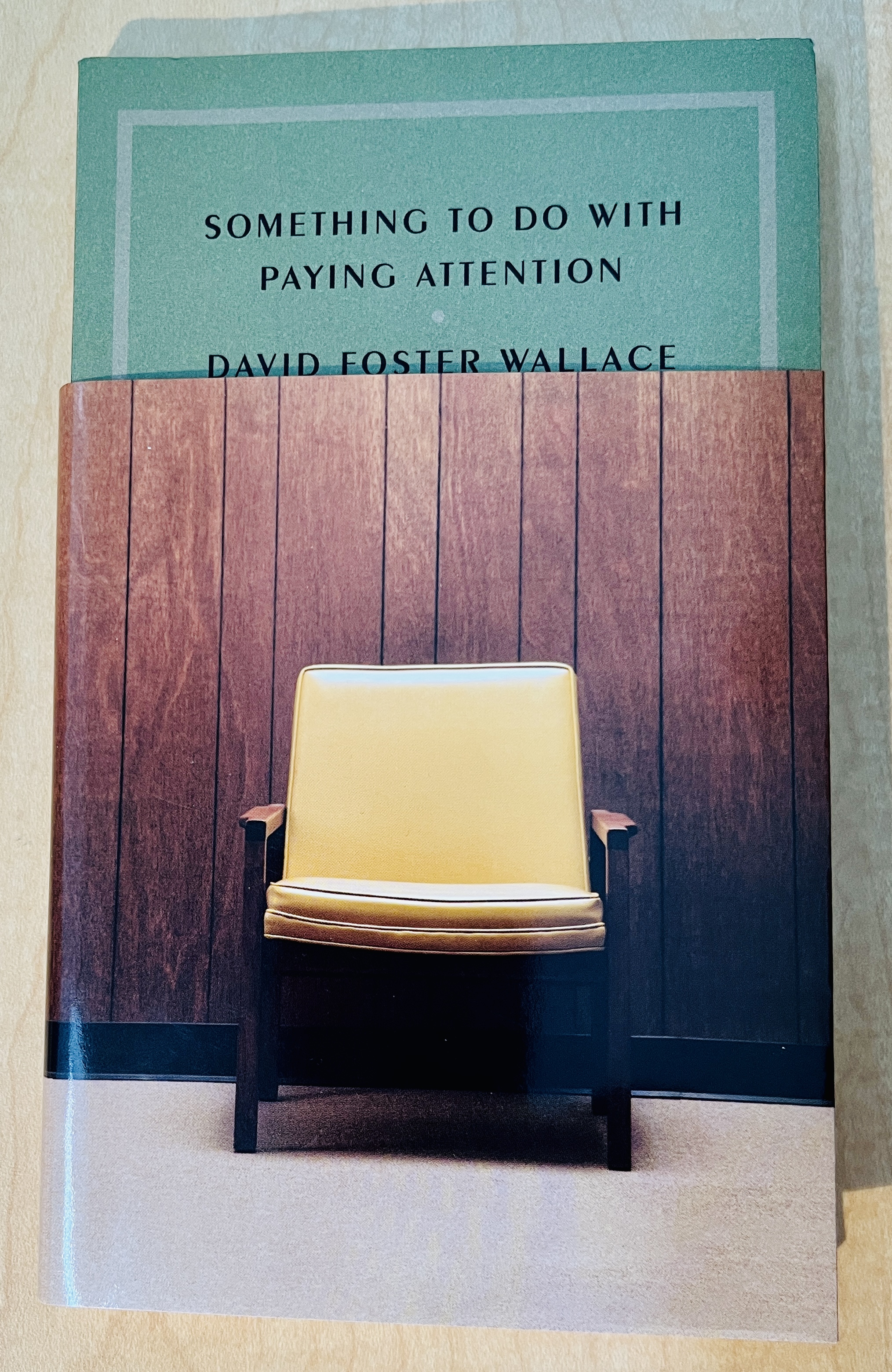
 Something to Do with Paying Attention, by David Foster Wallace. Pub 2022
This novella was only recently published on its own. It was originally a part of the last novel of David Foster Wallace, The Pale King. I have not attempted any Wallace fiction in any significant way before (I have previously read and enjoyed the essay collection Consider the Lobster), daunted by both the length and the purported impenetrability of the prose, described as “neorealism”. After my disappointments with James Joyce and Virginia Wolff, I didn’t think I could bear 500+ pages of stream-of-conscience. This short book seemed like a safe bet, and one I’m glad I made.
The story’s un-named narrator (from The Pale King, this is someone called Chris Fogle) is telling essentially his life story, motivated by a question about how he ended up in his career with the IRS. What follows is a very rambley and circuitous story of an ordinary man and his ordinary life, with some extraordinary moments and revelations. I was reminded in several sections of John Irving, how he could (in quite a different style) create great comedy and pathos in weird and ordinary situations. In this story, Chris is a self-confessed “wastoid”, spending his parents’ money and much of his own time quite literally doing nothing at college. His parents split up, his mother moving in with her girlfriend and opening a feminist bookstore called The Speculum. A few years later, his father is killed in a horrific subway accident. In his last semester at college, Chris has an epiphany, a revelation, an accidental set of circumstances that lead him to the IRS and his future. Presumably in the context of the novel his story continues, but the ending here, with his recruitment to the IRS, is a fitting end to this story.
The story also reflects the shifts in culture from boomers to Gen-x-ers, how their motivations could be and were/are so vastly different. Early on he notes, “My father, by the way, was raised as a Roman Catholic but had little or nothing to do with the church as an adult. My mom’s family was originally Lutheran. Like many of my generation, I wasn’t raised as anything.” This is almost a defining feature of Generation X, and perhaps is a contributing factor to the rootlessness that sometimes arises as ennui or apathy. Indeed, Chris eventually sees a distinction between his own “whatever” attitude in life (as in, I’m not really interested in anything) and his father’s “whatever” which accepted his lot in life, seeing questions like “do you like your job?” or “are you fulfilling your dreams?” as entirely beside the point. His father did “whatever” was required and expected, whereas Chris uses “whatever” as an open-ended approach to doing the exact opposite.
The style of the story was challenging and brilliant. Chris is in fact a terrible storyteller, one of those who makes a short story long. I lost track of the number of times he says “anyway”, “anyhow’, or “I don’t think I’m explaining this well.” But, unlike my previous encounters with realism, this was engaging and thought-provoking. There are some great sections about awareness (the “paying attention” of the title) and how being aware of being aware requires effort (or for him, drugs) – these sections reminded me of Trying Not to Try, which is definitely Chris’ driving philosophy for much of his life. The writings about the generational differences and his skepticism about evangelical epiphanies (a variation of which he ultimately has) are also interesting and engaging.
I don’t know that I’m up for a full Wallace novel, but I’m glad I read this one. Winnipeg connection: the publisher of this book, McNally Editions, is run by Sarah McNally, daughter of the owners of McNally Robinson books in Winnipeg. In fact, in the introduction, Sarah writes about meeting Wallace in a Winnipeg bookstore (I like to imagine it happening at the Grant Park store).
Fate: I’ll hang on to it for a while (it’s small).
4 – published in 2022
13 – set somewhere I’ve never been (Chicago)
 rclr
rclr 