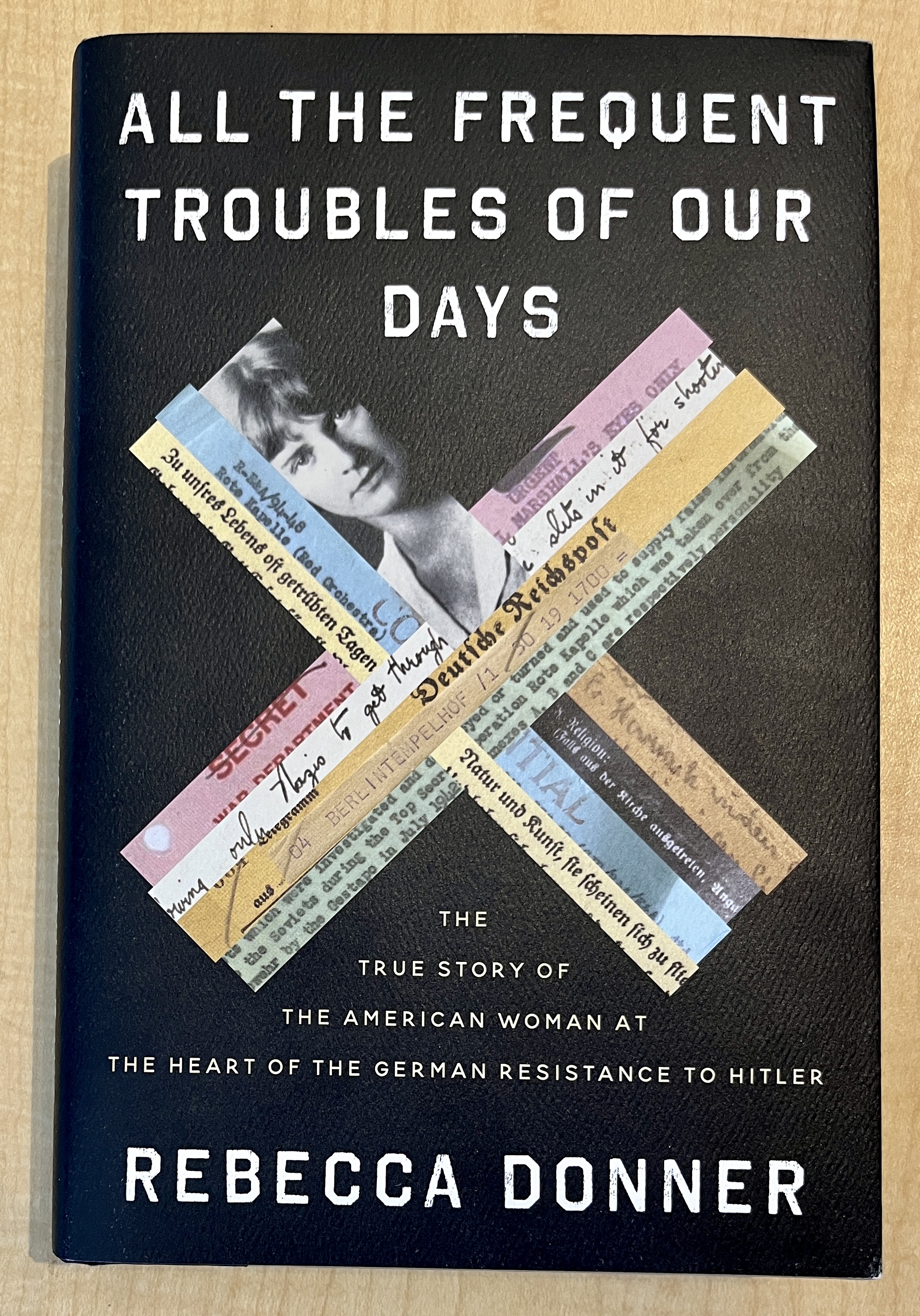
 All the Frequent Troubles of Our Days, by Rebecca Donner. Pub 2021
I can’t remember when or where I first heard of this book, but it would have been last fall sometime, as I bought a copy for myself and sent a copy to a friend.
Rebecca Donner is the great-great-niece of Mildred Harnack, an American woman who married a German economist and moved to Berlin in the early 1930s. An activist and champion of civil freedoms and workers’ rights, Mildred was witness to the erosion of society and government in Germany with the rise of Hitler and the Nazis, watching in slow horror as difficult times became a temporary emergency and then a longer-term emergency and then a dictatorship, all legally and with the support of the people and those in power. Once the freedoms were gone and the power handed over, there was no going back easily. In response to the decline into dictatorship, she helped established the diverse German resistance in Berlin and elsewhere. She was clever, careful, and committed, but her vision and work were undermined by the apathy of the world, the fear of her fellow Germans, the fervency of Nazism, and the incompetence of her Soviet collaborators.
Mildred is less well known than her contemporary, Sophie Scholl. Perhaps this is because she was older (Mildred was 40, Scholl just 22), or because her actions were less openly dramatic or defiant (Scholl was arrested after being seen tossing leaflets in a stairwell at the university). Mildred, with her husband Arvid and their “circle”, operated for nearly a decade, trying to bring attention to the dangers of Hitler’s rise from its earliest days, only to be disregarded both within and outside of Germany. The Harnack’s circle, along with others in Berlin, eventually included more than 400 people, including several of those who ultimately attempted the assassination of Hitler (the infamous Operation Valkyrie). The larger group was dubbed the Red Orchestra by the Abwehr, due its connections to and support from the Soviets. While it is hard to document a direct line between the actions of the resistence movement and Hitler’s eventual downfall, there is clear indication that their information and assistance to the Soviets was helpful in the eventual German defeats in Russia and Ukraine.
An important thread through the resistance story is the love story of Mildred and Arvid. They met in university in Wisconsin, and after a few years, in 1929, moved to Berlin, where Arvid was finishing his doctorate, and she was enrolled to start hers. In 1933, when rights began to be suspended, their situations changed drastically. Schooling for women became more difficult, and jobs for economists outside the government were equally challenging. They got by, but as academics and activists, they began their resistance work almost immediately. Over the years, they accumulated collaborators, made connections, wrote and distributed leaflets and letters, and collected and distributed information both public and secret. As an American, Mildred had access to high-placed people in both society and the diplomatic corps. As a skilled economist, Arvid was engaged at higher and higher levels within the government. They lived in a heightened state of alertness and caution almost all the time but were unwavering in their beliefs and their aims to restore rights and freedoms and defeat Hitler. They were careful and cautious in their actions, never using violence and taking smaller safer steps rather than larger risky ones whenever possible.
If only their Soviet handlers had been as careful as the resistance circle was, the ending might have been different, or at least delayed. Once the circle was revealed, the arrests and prosecution operation were sweeping and brutal. Like almost all the conspirators, Mildred was found guilty of treason. While she was initially sentenced to a long prison term, Hitler and Göring overturned that and sentenced her to death. She was beheaded in February 1943.
The book relies on the sparse official records and personal documents from Donner’s family. Following Mildred’s death and in the absence of any true information about what she’d been up to or how she died, her family chose to destroy most of her letters, photos, and documents. The Nazi’s went into their own frenzy of document destruction near the end of the war, and so most of the arrest, interrogation, and court documents were also lost. And in a sad twist, after the war, the US investigated her arrest and conviction and determined that, given the laws in place in Germany at the time (as unfair as they may have been), Mildred had in fact been the leader of a treasonous group, and so her conviction and sentence could be considered lawful.
Based on the available fragments of documents and many interviews with contemporaries of Mildred, Donner presents a compelling, complex, and page-turning story of a brave woman in dangerous times. The style reminded me of Erik Larson’s The Splendid and the Vile, with everyday scenes and conversations that must be created or imagined by the author but are realistic and serve to link the various known elements credibly and effectively without embellishment or artifice. It also tackles the difficult histories of the time – the bigger things happening in Germany and the world that were relevant to the story – in a way that is edifying but not distracting.
I enjoyed this book and learning about this forgotten figure and group. I can understand why they are less well known – careful and quiet rebels whose records are mostly destroyed – but that doesn’t make their accomplishments less worthy or their deaths less tragic. The book was also a useful history of living through the rise of Nazism and a clear warning about both taking freedoms for granted and about trusting too much in those with power.
Fate: I’ll be keeping this one.
8 – a female author
23 – memoir/biography
25 – new author to me
31 – history/politics
33 – Canadian author
 rclr
rclr 