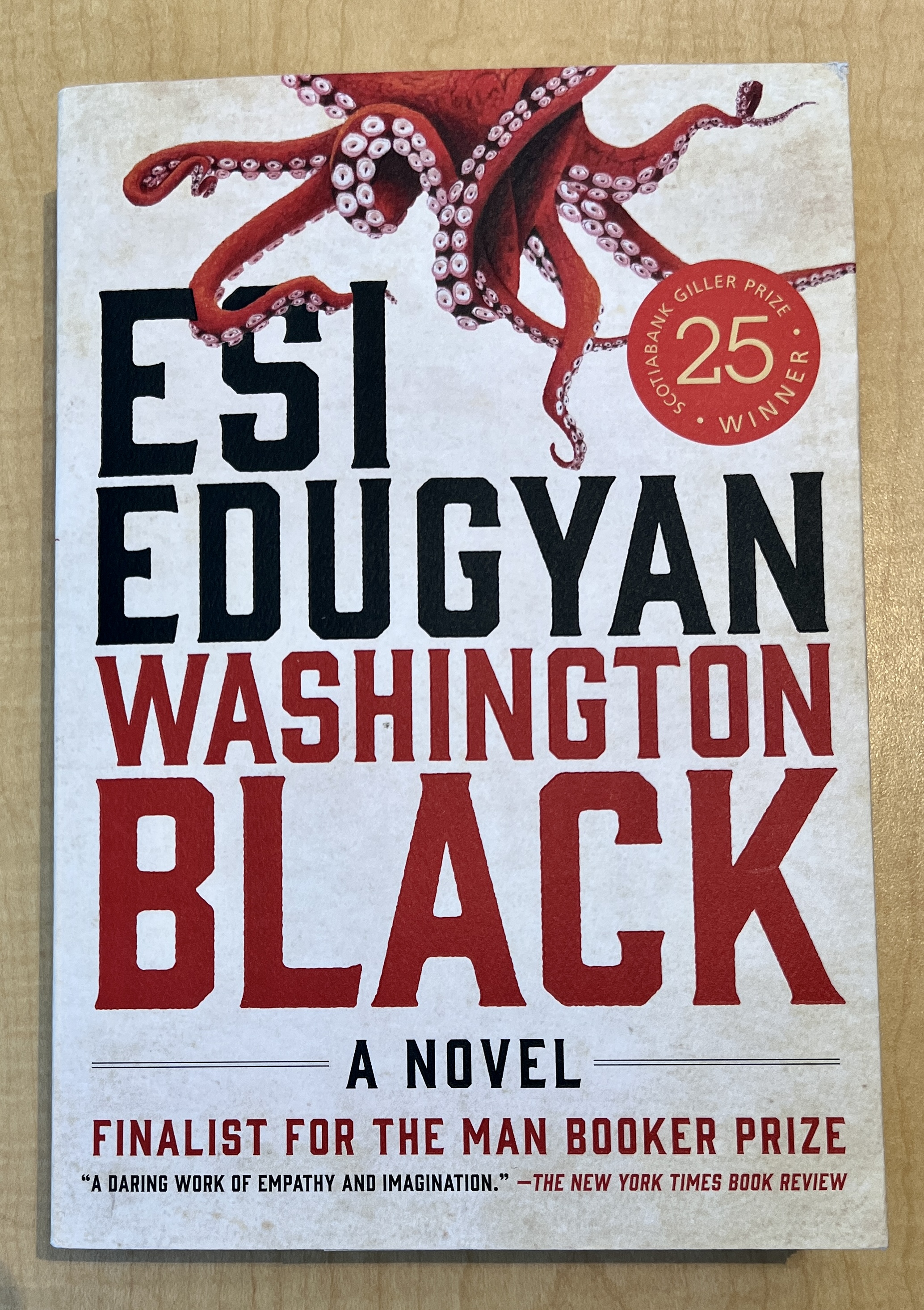
 Washington Black, by Edi Edugyan. Pub 2018.
I’ve had this one on my shelves for a while now, and recall starting it at least once but getting distracted from it as it seemed to be going in a very bleak direction. But a few months ago, another reader friend mentioned having finished and enjoyed it, so up it rose in my own reading list.
The eponymous Washington Black tells his own life story from his earliest days as a cane plantation slave in Barbados, through some remarkable adventures and escapes, and journeys that take him to the Arctic, England, and North Africa. Born in 1818, Wash, as he’s known by most people, is selected by chance at the age of 12 to help the brother of the plantation owner with a series of scientific experiments involving an early aerostat – essentially a hydrogen-filled balloon that the brother (Titch) plans to fly to another Caribbean island. Titch introduces Wash to science, reading, and drawing, encouraging and enabling his talent for drawing and his interest in marine animals. An accident on the plantation compels Titch to launch the balloon and escape with Wash, thus beginning a journey North to find his adventurer father in the Arctic – a journey even more perilous for young Wash, a young, disfigured, Black man and a runaway slave. Fortune is somewhat on Wash’s side as, despite violence and difficulties, he manages to make his way to the Arctic with Titch, and then back again to Nova Scotia, settling down somewhat in an area where his appearance and background would be less conspicuous and dangerous. He tries to make the most of his freedom, but remains afraid of discovery and feeling guilty for those he left behind on the plantation. There follows some coincidental meetings with others, a strange romance, an even stranger opportunity, and more travels – to England, then Amsterdam, then Morocco – as Wash seeks to reconcile his past. All of this before he’s 20 years old.
The novel is good – well written, with clear and complex characters, and a story that has you rooting for Wash and gasping at some of the twists in the story. While enjoyed it, I found some elements of it just too fantastic or unrealistic. For example, no matter how sympathetic those around him may have been, it seems very unlikely that Wash, as a young Black man, would have been permitted to travel as freely and in many levels of society and the scientific establishment – and alone with young, unmarried, white woman as his lover – as he does in the novel’s mid-1830s Canada and England. (Perhaps this is a prejudice of my own, but I think it’s more a historical fact than my own bias.) There’s also some selfishness in Wash that was difficult to reconcile. He is a very young man, just a child in some of the more difficult parts of the journey, but I found it difficult to reconcile the talent, perspicacity, strength and maturity he brings to many tough and tragic experiences with the petulance and immaturity shown in addressing the people of his past and present. He wants to be recognized for his contributions and talents without acknowledgment of having overcome the difficulties of his past – when someone notes how much he’s accomplished and overcome, he becomes violently offended – while at the same time often turning to look at his past almost longingly and with no acknowledgement that, yes, his life is better than he could have imagined or expected. In this, he is lacking in grace and gratitude, intent on seeing only the lack in his life. This made some of the fantastic elements of the story, especially the independence with which he moves and travels, less believable – even perhaps unreliable – and eroded some of this reader’s sympathy for him.
There are also a few loose ends with some elements and characters that felt untidy. For example, there is an octopus that plays a significant almost symbolic role in a part of the story (indeed, its image is used on the cover and section dividers). After being miraculously transported from Nova Scotia to England for the live display being planned by the science folks, the octopus becomes sickly and there is concern that she will not survive for the opening of the show. However, neither the opening of the show – this event that will be the launching of his career – nor the fate of the octopus are resolved at the end. I think the ending was the most disappointing, as so many things are left unclear and unresolved. After so much travel and details about his life, Wash’s fate and remaining life are left with a question mark.
It sounds like I didn’t like this book – I did enjoy it, especially the writing and pace of the story, and the truly fantastic journey of Wash through the world. Less compelling was his internal journey – that I found confused and unsatisfying.
Fate: charity shop.
1 – a book wth a murder
8 – female author
14 – a name in the title
16 – a colour in the title
25 – a new author to me
29 – leftover
33 – Canadian author
34 – won a prize (2018 Giller prize)
 rclr
rclr 