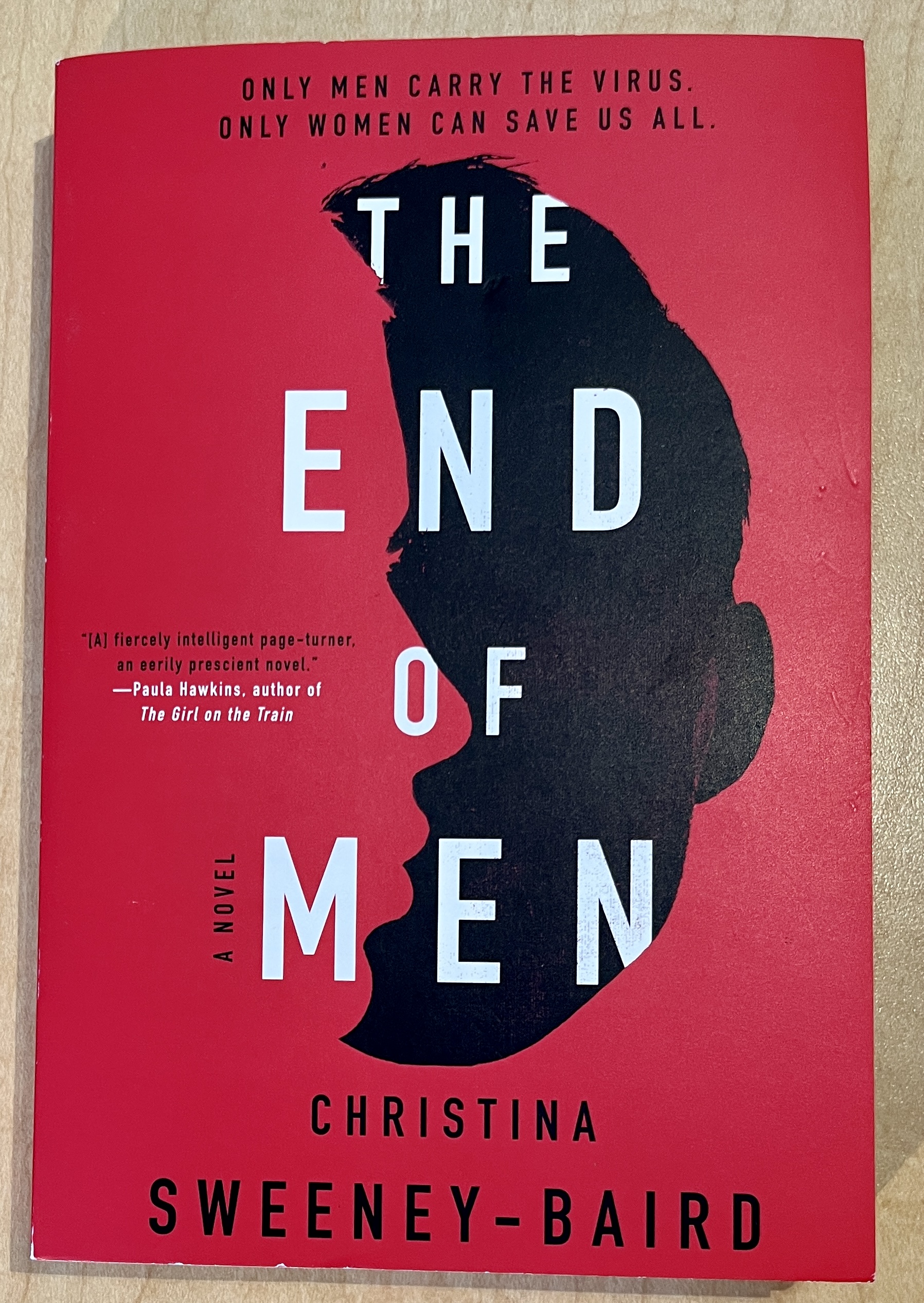
 The End of Men, by Christina Sweeney-Baird. Pub 2021
This was an impulse bargain buy at the local bookshop. It looked like a companion piece to The Power, with a different premise but same subject matter: what would the world look like if men were no longer in charge. A key difference: this book was much better. Spoiler alert for the rest of this report.
In the story, in late 2025, there is a pandemic that begins a bit quietly and suddenly, then spreads quickly with devastating effect. The Male Plague, as it comes to be called in the novel, is a virus that infects everyone but is only symptomatic in males, with a 90% mortality rate. Women are immune, but are also asymptomatic carriers of the virus, becoming vectors of devastation in their own families and lives. The reactions and responses of the world and of individuals are random at first, as little is known about the nature of the virus. But the loss, grief, and despair run as rampantly as the virus itself does in the population.
As a result, the novel explores several themes: the pandemic, the disease, the responses, including government policies such as lockdown and scientists’ approach to investigation and research; family dynamics and relationships in different cultural settings; the devastation wrought and changes required as nearly 50% of the population – 90% of males – die in a short period of time (it takes just over a year for most of the loss to occur). The social, political, economic, and resource upheaval is something one might understand logically but distantly; the author does an excellent job of presenting a realistic and frightening picture of it. Dystopia? Utopia? Horror story? Scifi? This book is tough to classify that way.
The novel is told as a series of first-person narratives, each chapter the journal entry or piece of the story from the character’s perspective. There is a single “before” section, and then all chapters are presented chronologically, dates as number of days after the start of the pandemic. There are several recurring voices, plus a few single entries, and almost all of them are women. Many of these are sympathetic – people confronted with fear and chaos and significant personal losses that they don’t understand, at a time when loss has suddenly become the norm. Each experiences grief in their own way, and becomes a participant – eager or reluctant – in the tectonic shifts in society. Women are now responsible for jobs in all areas, and occupy all seats of power around the world. In some areas, this is good; in others, not so much. By the end of the novel, 7 years have passed since the start of the pandemic. The new normal is still very new for everyone, and so it is too early to tell if this new world order can be sustained with positive results, or if the near inevitable corruption of power will emerge.
This was something I quite liked about the novel – that each woman is unique, and there is no stridency about the assumption of power by women or any suggestion of revolution or vengeful victory with the loss of the males. Each is allowed to experience their losses and decide on their role in the new world on their own, with few expectations other than that they WILL contribute. It may have been a bit more balanced to have a few more extreme voices represented – the radical feminist celebrating the death of each man as a victory of some sort; the privileged and the celebrity still expecting a return to a world where they are catered to; and those who were used to and comforted by a world that was quite narrow, just them and their family, having difficulty adjusting to a society that no longer has a place for them to be insulated from hardship and change. Regardless, the stories that are told are balanced and raw and feel real.
As an examination of a pandemic, some might see this as a bit too soon for comfort. The novel was written almost entirely (according to the author’s note) before COVID-19 was a thing, arriving at the publishers in January 2020. Assuming that is true (who knows with marketing messages), the novel is wildly prescient. There are a variety of lockdowns and travel restrictions, as well as individual countries doing their own things regarding their populations. While many are reminiscent of COVID times, a big difference is both the scale of the impact and the population affected by the virus. In the novel, with only males being affected, industries that are primarily male were devastated, with devastating consequences. Emergency workers, doctors, pilots, tradespeople, resource workers (think miners and oil workers), sanitation workers, the military, big business, and government – any area that is currently dominated by males is suddenly no longer functioning. As such, many of the privations that become imposed on the populations are not poorly-informed policies of governments but are practical responses to the situation. Regardless, the similarities are a bit eerie.
It’s not perfect. The book tries to deal with two different main themes (the world in a pandemic and the world without men), and while it does a good job with each, there is perhaps a bit more that could be done with both. As above, different voices that consider primarily the loss-of-males theme might have added some texture to that theme. On the pandemic side, there could have been a bit more about the economic changes that were wrought. One character (the only ostensible villain) manages to become ridiculously wealthy after discovering a vaccine; but in a world where luxuries are not just expensive, they are unavailable, what value is there in being a billionaire? But perhaps that’s a whole other story.
Fate: I might hang on to this as part of my dystopia collection.
1 – a book with a murder
7 – author’s debut
8 – female author
25 – a new author to me
 rclr
rclr 