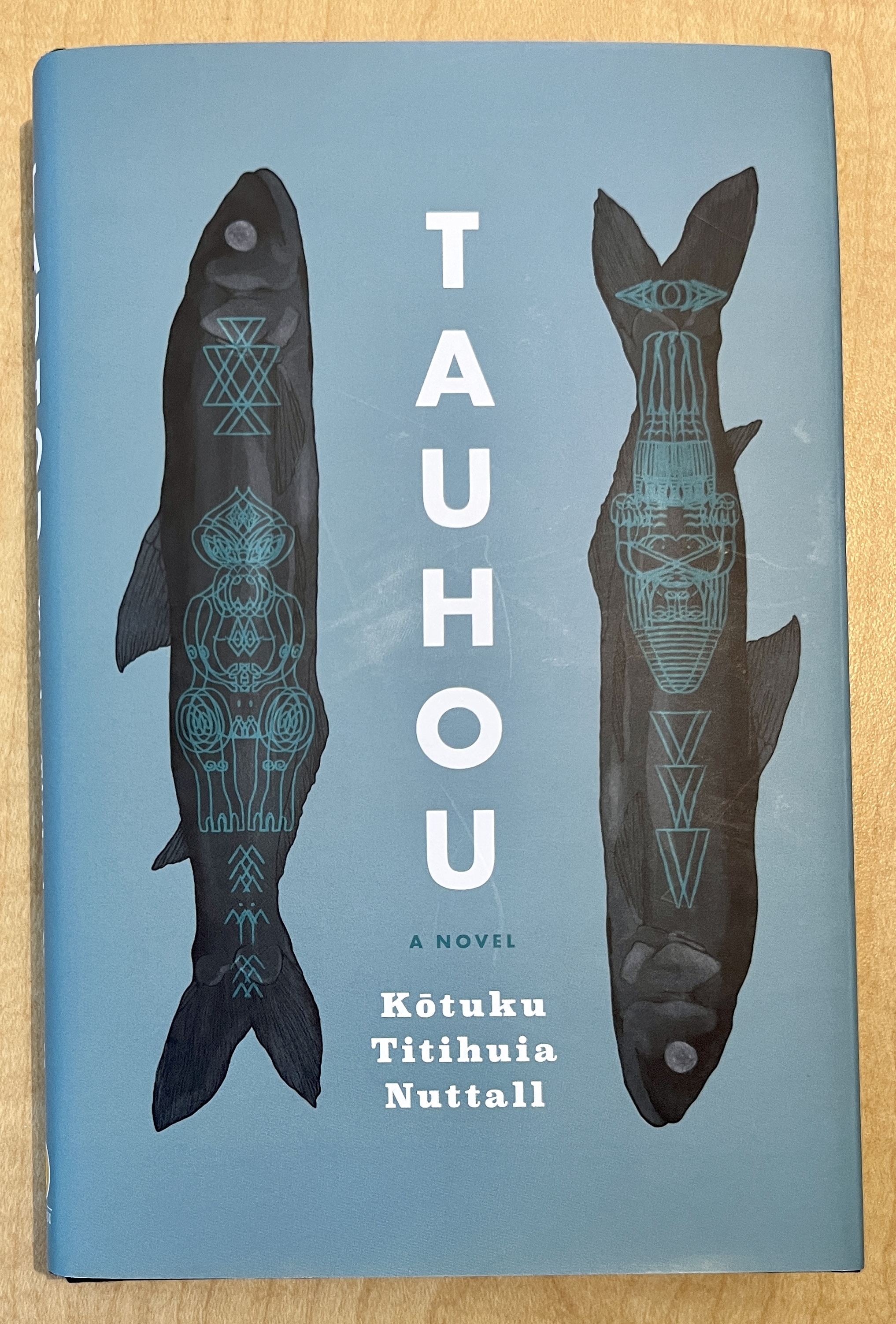
 Tauhou, by Kōtuku Titihuia Nuttall. Pub 2023
This was an impulse purchase last month when picking up some other books. I’ve been encountering situations with Indigenous communities and relations more and more in my work, and so this book seemed like perhaps a timely way to engage with those, however obliquely. However, the author herself proscribes such engagement, saying in the afterword, “This work cannot and should not be used to educate oneself…it is purely fictional.” Still, I do feel I learned a bit about experiences of cultural and generational disruption. And while I found the writing compelling and evocative in many ways, I found the strange structure of the book less so.
Nuttall creates a fictitious world based on real locations, cultures, and events. The world of Tauhou is a mash-up of Coast Salish and Maori cultures in a location that imagines Vancouver Island as located in the Southern latitudes and within sight of the South Island of New Zealand. It seems to move backward in time somewhat, starting in a period where climate change has affected the coastal urban locations and moving backwards to times of colonization. Familiar elements from history and culture appear, including the removals to residential schools, the prevalence and significance of tattooing in Indigenous cultures, longhouses and communal living in Indigenous communities, large and interwoven families, and the disruptions and impacts of substance use, subsistence living in the modern age, and mental health challenges. The blending of cultures, geography, and history was fascinating, and Nuttall vividly brings this world to life.
The “novel” is so unusual in form that I feel compelled to put it quotes like that. Divided into 4 sections, working backwards in time, each section consists of several short chapters that are more like stand-alone stories, ranging in length from barely one to several pages each. There are few consistent characters, locations, or situations across the stories, so there is no narrative flow to the novel. The constant is the somewhat grim and haunting mood of everyone and every place. This makes it difficult to learn about or empathize with any of the situations or characters, as the reader doesn’t get to know any of them long enough to learn about them, other than that they are sad or lonely or frustrated, with only strange or almost mystical suggestions as to why. While there are many family relationships (and so male-female relationships), these are not portrayed as happy or successful – all are sad and tragic. The main relationships that do appear with the focused characters are female-female, either as sisters, friends, or partners (lesbian or queer), and while these are somewhat happier by comparison, there are few situations of joy or contentedness for anyone in the book. The book just comes to an end with the last story, with no resolution for anyone, which is perhaps the ultimate message.
It’s a hard book to say that one liked, or to recommend as it is both weird and compelling, beautiful and yet a bit distant. While I did learn a bit, I did also feel that, despite the creative blending of cultures, etc., I didn’t encounter anything new.
Fate: I’m going to offer it to another reader. If they’re not interested, it will find its way to a charity shop or little library.
4 – published in 2023
7 – debut
8 – female author
13 – somewhere I’ve never been (the main locations are clearly New Zealand rather than the author’s imagined and well researched Coast Salish culture).
20 – a one word title
25 – a new author to me
37- non-mainstream
 rclr
rclr 