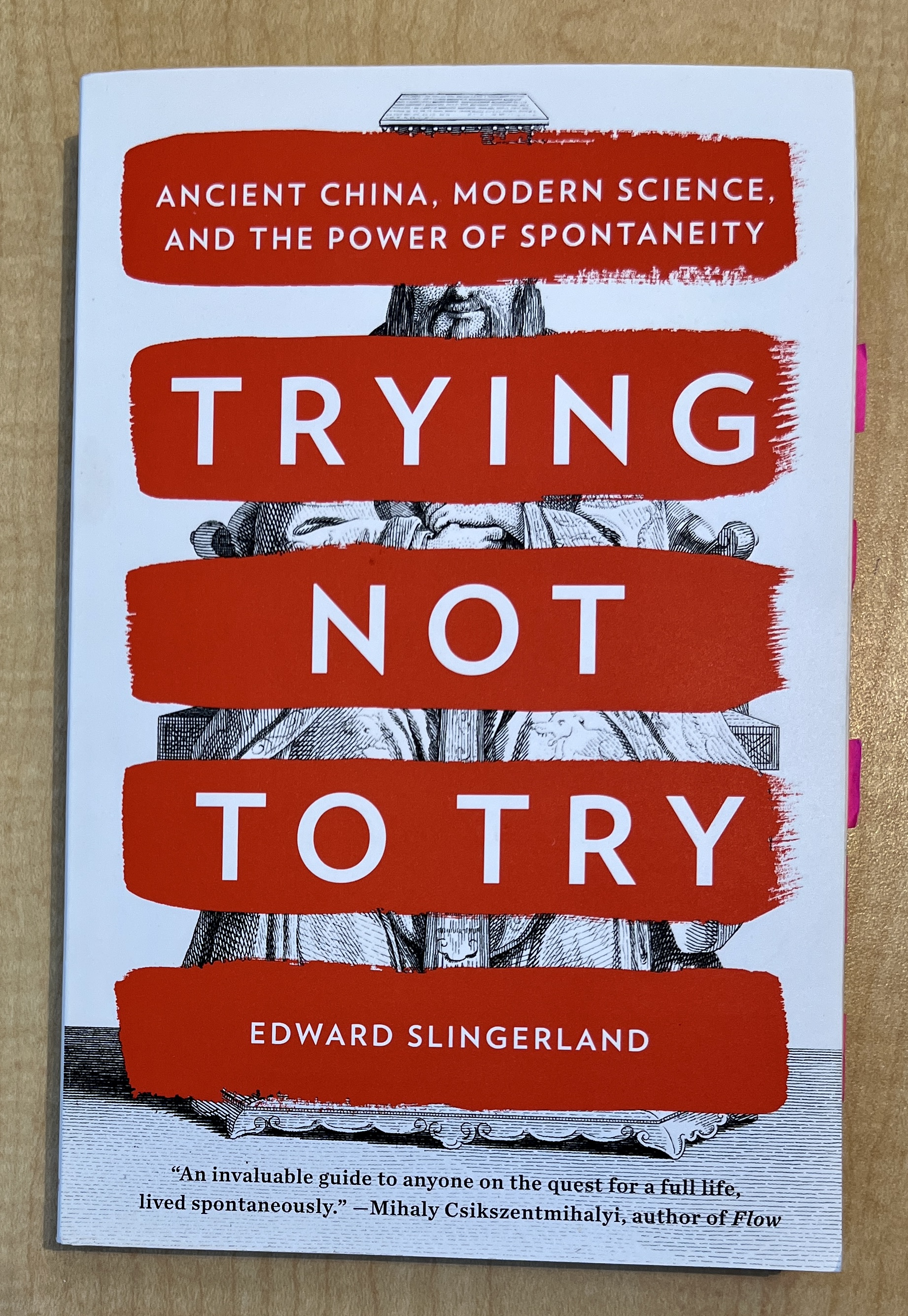
 Trying Not to Try, by Edward Slingerland. Pub 2014
Is this familiar? You’re trying to remember something and it’s just on the tip of your tongue but you just can’t get it. You try hard to think of it, but get more frustrated, and the answer seems even more elusive. Then, as soon as you think about something else, the answer comes to you.
Or this: you’re working on something and it’s going really well. Before you know it, an hour or two has passed by and you didn’t notice. You don’t recall exactly what you did during that time, but you can see what you accomplished, and it feels brilliant.
I do not recall where I first heard of this book, but I do recall why I was interested in it. I had a discussion with a colleague about leadership and my own experiences, and they gave me what they thought was a compliment: that dealing with challenges, in situations or with people, seemed to come easily to me, I made it look effortless. While they weren’t suggesting that I had it easy, their perception that things that appeared easy must be effortless belied the incredible amount of time and effort (and numerous failures along the way). I gently but quickly corrected their misinterpretation. Like many people who do some things well, even expertly, it takes a lot of effort to make something look effortless. We are ducks paddling like crazy below the surface while appearing to calmly move through the water. And like the examples above, there are often situations where we can do a lot with what feels like little effort or even the opposite of effort – by letting go.
I was keen to explore this concept, and then I heard a podcast on Infinite Loops with the author, so I sought out the book. I was somewhat daunted by the subtitle (“ancient China, modern science, and the power of spontaneity”), but at a modest 200 pages, it seemed worth a try. Armed with post-its and a highlighter, I dove in. Slingerland is an excellent author, taking dense and complex ancient texts and presenting them in clear and accessible prose. The result is a look at the concepts of wu-wei (pronounced “oo-way”) and de (pronounced “duh”) that essentially mean “effortless action” and “charismatic power” respectively. Slingerland presents these concepts as things to aspire to, and outlines the various approaches to them in several Chinese texts – two based in Confucianism and two in Daoism.
In Confucianism (both standard and Menciusian, the emphasis is on trying – working really hard to get so good at things (including being human) that they just happen naturally. There are lots of rituals (ex. how to position a pillow before you sit on it) and long texts to memorize and a whole way of life of constraint and, well, trying. In Daoism (whether from Laozi or Zhuangzi), the emphasis is on NOT trying – stop trying altogether and just go with the flow; in this approach, there is still some structure, but no formal rituals. Slingerland presents each of these philosophies in easy to understand prose and stories, and interweaves the latest in neuroscience and psychology (plus some evolutionary biology) to show how these various ancient texts were very ahead of their time. To me, there are clear linkages to other recent books, such as Thinking Fast and Slow by Daniel Kahneman, Atomic Habits by James Clear, Flow by Mihaly Csikszentmihalyi, and The Obstacle is the Way by Ryan Holiday. Not that any of these are similar or the same, but that the insights they deliver – about thinking, habits, perseverance, and flow (obviously) – align with those that Slingerland shows us were present in China nearly 4,000 years ago.
Ultimately, we get to the paradox of trying not to try, which is that the more you try not to try, the less effective it is. The focus throughout is on spontaneity, and if it can be cultivated and still be natural. The answer, it seems, is no. The objective is to learn how to live with the paradox – try hard sometimes, go with the flow in others. Which approach one takes depends on so many factors that there is no solution, no “way” to try not to try. And that’s likely just fine, as artificial de is undesirable; someone faking it – be it confidence, positivity, or affection – is always seen or eventually revealed to be a fake.
I think this is also always why programs in school or in research that try to create or force imagination or innovation so often fail; those sparks of genius that create new things to save the world have to just happen, and the more we try to make them happen, the less likely they will (they may come, but at a very high price). We can create environments for them – quiet spaces, adequate resources, good education – but cannot have expectations of outcome.
This book was readable, interesting, and enjoyable, with lots of food for thought about effortless action, including perception by others that an action is effortless even when there’s a s$#t-ton of work behind it.
Fate: my copy is all marked up, so I’ll be keeping it.
7 – a debut book
25 – a new author to me
21 – history/philosophy
33 – Canadian author
 rclr
rclr 