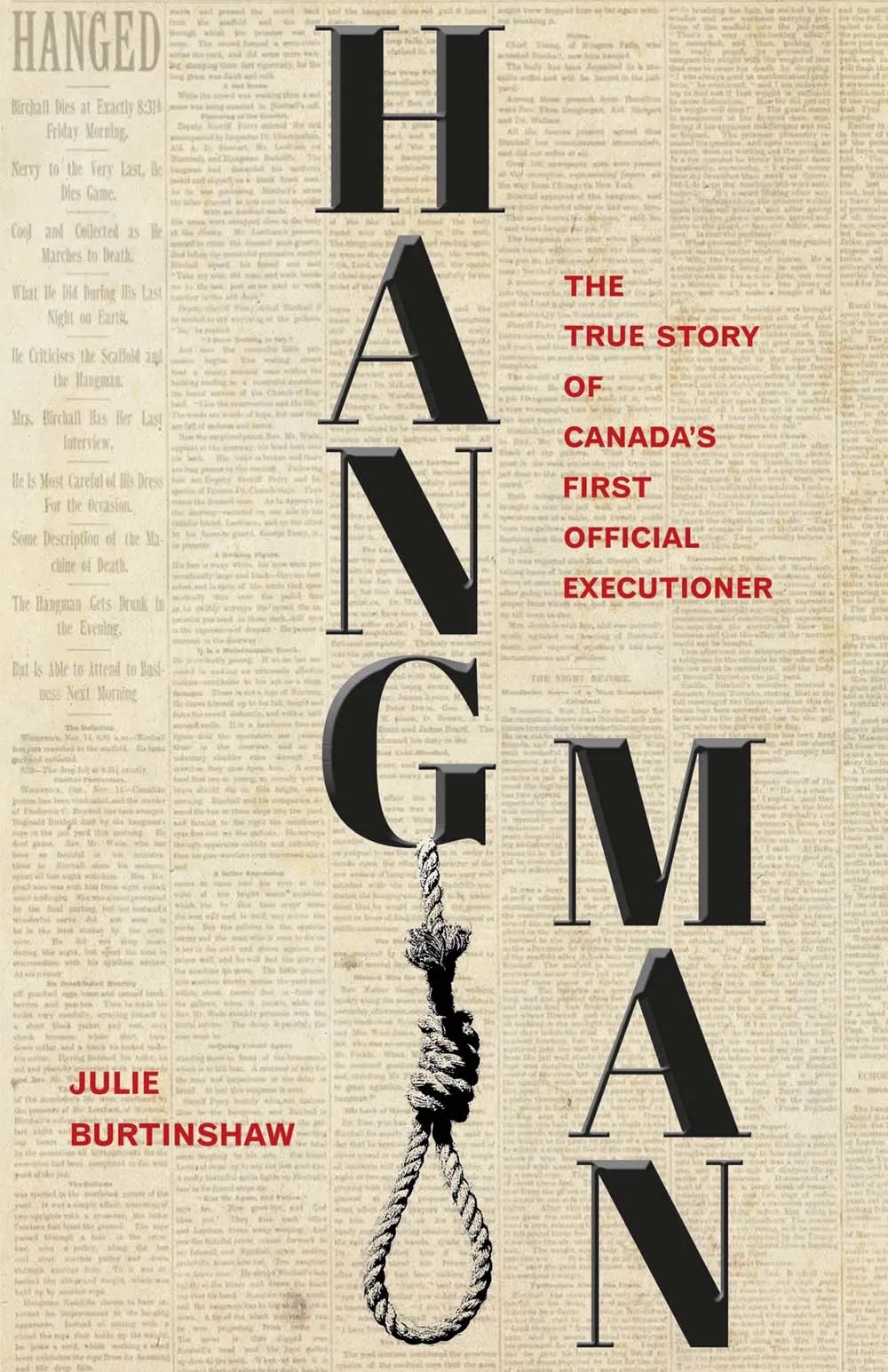
 Hangman, by Julie Burtinshaw. Pub 2022
I purchased this book because it is written by a friend-of-a-friend, and because I thought it was something my mom might enjoy. This is the story of Canada’s first official executioner, one John Radclive (or Ratley or Ratcliffe or Radcliff as he variously calls himself). Drawing heavily on Radclive’s own diaries and other historical documents (I assume this, as no bibliography is provided), the book is a non-fiction novel, aspiring to the style of Truman Capote (In Cold Blood) or Erik Larson (The Splendid and the Vile), where history is re-imagined by the author and the blanks between known facts filled in with fiction. Here, we are presented with the supposed inner thoughts and private experiences of Radclive and his family as they emigrate from England to Canada. Radclive secures a good position at a new rowing club in Toronto, while also developing his skills and reputation as an executioner – first quasi-volunteering for the role, and eventually successfully lobbying for official appointment by the Canadian government. This dual identity ends up causing problems for Radclive (he loses his job at the club) and his family (they are ostracized in their community and his son is bullied at school). His arrogance and alcoholism combine to eventually drive his family away. His early death from alcoholism seals his fate as the ignominious and loathed figure he wanted to avoid.
Radclive aspired to the role of executioner for odd reasons. During his early career with the British navy, he took on the role of ship’s executioner with a strange near-zeal, ostensibly motivated by the desire to make the hangings as humane – quick and painless – as possible. Back on in England, back on land and in society, he felt a calling to continue to try to serve this function, as hangings were still fairly frequent, common, and public. He attempts to mentor with another professional but is rebuffed and so somewhat petulantly relocates to Canada to try his hand at it in a new location. Despite being successful in achieving his goals, including the implementation of more humane methods across the country, he never manages to overcome the public’s revulsion at his chosen profession, and does little himself to redeem the role. For much of his life, he railed at this hypocrisy – how could people desire and cheer for capital punishment and yet abhor the instrument of that desire? This is how he viewed his role: the dispassionate executioner of the state’s judgement on the guilty, not as the executioner of the individuals. While he is sometimes quite eloquent in his expression of this belief, his temperament was impatient and he would often be deliberately belligerent with others. None of his was helped by his drunkenness or his big mouth, as he often bragged about his profession, told wild stories in barrooms and to reporters while drunk, and sold off the trappings of each hanging as macabre but profitable souvenirs.
Much of this character is likely invented by the author – if there are any records, they are likely sparse, with very likely little record of his actual interactions with people, including those who were hanged by him. Similarly, the lives of his family and his colleagues would also be invented. And all of this could have been quite interesting. However, the writing is a bit wooden in places, the tone shifting from journalistic to romantic to melodramatic throughout. There are also a few bits that could have benefited from more judicious editing, especially around some of the dialogue and descriptions of the inner feelings of Radclive, where words like “hatred” and “anger” are used so frequently they become somewhat dull. There is also lots of confusion created by the multiple names he uses, which is not very well explained. He changes his name somewhat when arriving in Canada, becoming John Ratley for his various employers, and adopts John Radclive for his executioner’s identity purportedly to keep that role and work separate from his personal life. All of which would make perfect sense if he didn’t immediately start telling everyone that these personas were one and the same, bragging about his important role and relishing the spotlight but resenting the corresponding censure that his work brings to him.
Radclive was Canada’s first (and presumably last) official executioner. After his death in 1911, the government did not appoint a replacement, although it does seem that a few others took over his work for several decades until capital punishment stopped being used in Canada in 1963. Radclive did seem to be unique in his approach to the role as a profession, taking as much care as possible with the convicted persons, and regularly and vigorously objecting to the public spectacles that often took place at hangings. He introduced the so-called “long drop” method into Canada and worked to use it wherever possible to ensure a quick and painless death for the person hanged. Whatever his other many failings in his career, he was not a bloodthirsty or sadistic killer, and near the end of his life even appears to have shifted his beliefs to no longer support capital punishment (although not sufficiently to give up the government position and pay, nor the aggrandisement and strange glamour of the role).
While the book has some challenges in terms of the writing, the material is interesting, as is the portrait of Canada at the turn of the previous century, with its emerging cities, culture, and society. While Canada was certainly more democratic and egalitarian than England, it was far from perfect, and issues of class and discrimination followed all immigrants from their former homes around the world. Radclive is not someone to be admired or envied or understood, but his story is an interesting reflection on that time in history, and this portrait of a man in such an unusual profession is provocative and worth the telling and the reading.
Fate: passing along to my mom as planned.
1 – a book with a murder
4 – published in 2022
8 – female author
20 – one-word title
25 – new author to me
31 – history/politics
33 – Canadian author
 rclr
rclr 