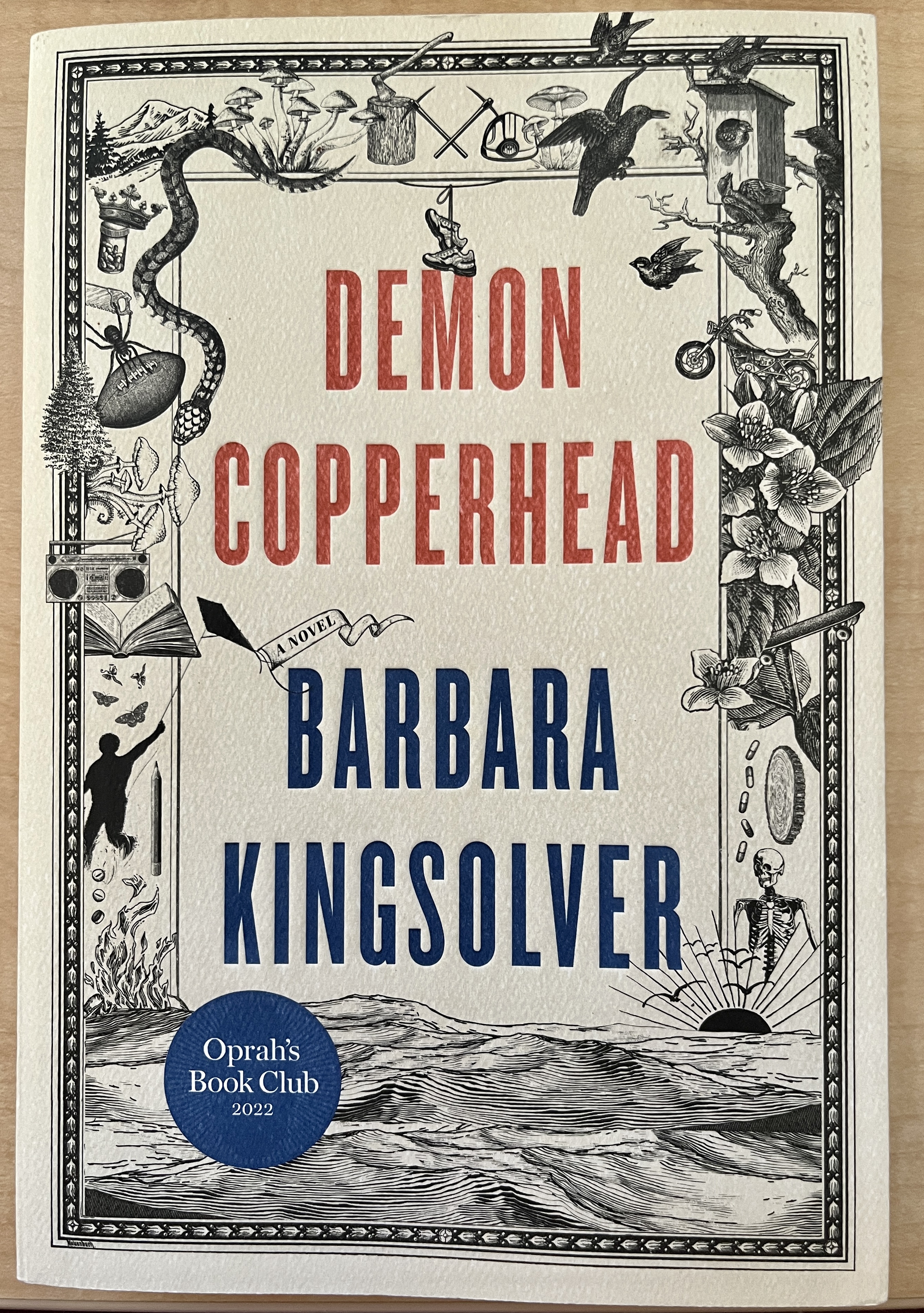
 Demon Copperhead, by Barbara Kingsolver. Pub 2022
After reading Kingsolver’s previous novel Unsheltered, and really not enjoying it, I was tempted to this one given its premise: a transcribing of David Copperfield into the Appalachia. This would have been less appealing were it not for my having recently completed the audiobook of the Dickens novel, and loving it. I was at last familiar with those characters and stories, and the opportunity to read them again in a newer setting was intriguing. And this time, Kingsolver did not disappoint.
Damon Fields is known to most as Demon Copperhead, due to his recalcitrant and defiant nature and his wiry red hair. He is also a Melungeon, a person of mixed and unknown background with darker skin. Demon is born in the late 80s to a single mother with drug and alcohol addiction. His early life is difficult to say the least, with neglect, abuse, poverty, and ultimately fosterhood creating a perfect storm of misery. In his early teens, he gets a break – near-adoption by an actual relative and shelter in a decent home with opportunities. However, throughout and despite this shift in fortunes, he feels always that his situation is tenuous – a teenage version of imposter syndrome – and so behaves in ways to fulfill his own prophecy of despair and disappointment. He falls in love with a troubled and difficult girl, gradually leaving behind his good fortune and opportunities for a life of dissolution that is sadly a repetition of his own parents’ circumstances. There is eventually recovery and redemption, but not before much more heartache for everyone involved.
It was truly delightful to see the familiar Dickens characters emerge and the journeys of David Copperfield re-told in modern settings, with all their seediness intact. While the living conditions and state of society in the 1850s can seem unfamiliar or quaint when reading Dickens, they become familiar horrors in modern times, especially the too-young children taking on the tortures and abuse of adults and society. Like in Copperfield, some come out the other side of that successfully, but most do not. And those that do bear the scars of their past in clear and tragic ways.
Like for Dickens, institutional poverty is a focus for Kingsolver, enhanced by the scourge of opioid addiction. There is much in the story about both the targeting and subsequent neglect of this region of America by pharmaceutical companies and the government, layered on to a region that had suffered neglect back generations, right back to the founding of the US. While there are elements of the Demon character that might seem standard fodder for a story about racism, a main element is the discrimination of the Appalachian people as a whole – the familiar trope of the ignorant, dirty hillbilly, the redneck, which is the root of the devastation of the opioid crisis in that region.
My issue with Kingsolver in Unsheltered was primarily the preachiness – a finger-wagging ranting by several characters that made most of them either boring or unlikable, but also made the reader forget what the book was actually about. In that novel, the author had many things to say but let that get in the way of the story such that it read like a very obvious and tedious fairy tale. With Demon, Kingsolver has returned to her prime, setting characters in lives and situations that enable these social and ethical perspectives to come out more organically, with the story communicating the messages rather than the author shouting them. It’s not perfect – I think the character of June (one of the few who does not have a Dickens heritage) is a kind of stand-in Kingsolver herself, as June is the most energetic soap-boxer in the book – but it is overall very well done.
At >500 pages, it is a substantial tome, and yet could have benefited from a longer, softer landing. Most of the storylines wrap-up a bit quickly or are even left unfinished, unlike Copperfield which is truly his entire life. If Demon is born in the late 80s, by the novel’s end we’re barely into the 2010’s. Perhaps since much of the social situations in the novel are also still present and unresolved, the open ending could be seen as reflecting that reality or even a possible hope for a better future. But I would have liked to learn about the final outcomes for many of the characters, including Demon.
I was reminded in reading this of previous novels with a similar conceit – a modern re-telling of an older tale (think the Hogarth Shakespeare collection). This was a good as those, especially Macbeth and Hag-seed. I do wonder if it would be received as well by someone unfamiliar with the Dickens original.
Fate: it will stay on my shelf with my collection of Kingsolver favourites.
4 – published in 2022
8 – a book with a female author
13 – set somewhere I’ve never been
14 – name in the title
28 – an old favourite author
34 – winner of a prize (2023 Pulitzer)
 rclr
rclr 