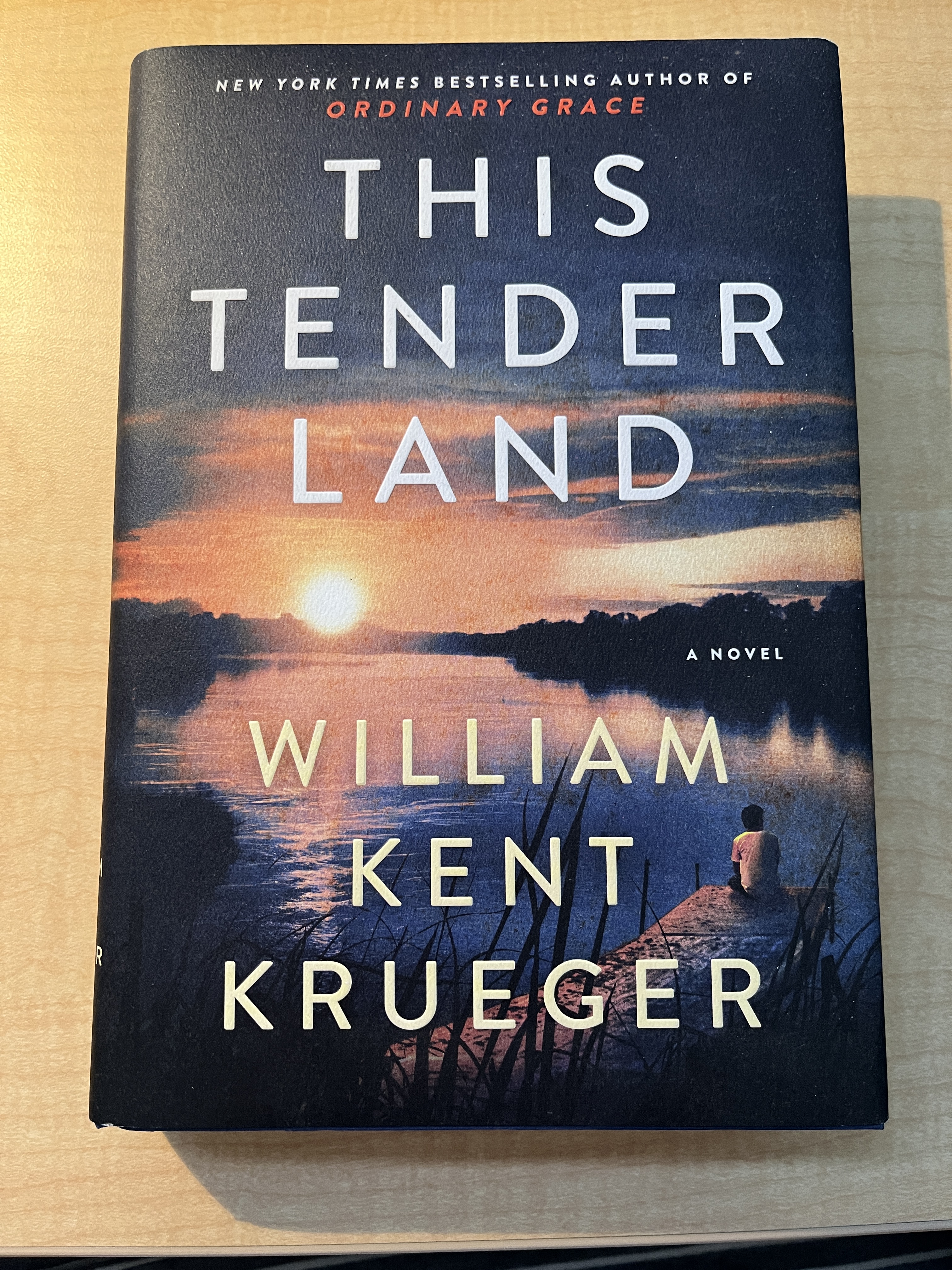
 This Tender Land, by William Kent Krueger. Pub 2019
This is not a book I would have picked for myself, but came as part of a bounty that I won in a prize draw at my local bookstore. There are a few from that set that are on my to-read list, and some others that will eventually go right to charity. This one was almost headed there as well, but in that same week my cousin recommended the book as a “must read”. So, I started to give it try, and found I could not put it down.
Set just a few years after the Great Depression of the last century, it is the story of four children – Odie (the main character and narrator) and his older brother Albert; Mose, a Sioux boy who cannot talk but uses sign language to speak; and Emmy, the orphan daughter of the children’s favourite teacher – who run away together from a residential school. The school as is dismal and horrible as any in fact or fiction, complete with sadistic “teachers” and the evil owners who get rich off the money intended for the residents. After a tornado rips through the area, killing the favourite teacher and making Emmy an orphan, the evil headmistress essentially kidnaps the little girl, intending to “adopt” her (and thus claim her mother’s land as inheritance). Odie, the bravest and most volatile of the bunch, has an altercation with a particularly bad teacher, and after that violence needs to leave. The others follow (they take Emmy, just a young girl but with a strange wisdom and light to her, as well as what appears to be epilepsy) and they make their escape down the Minnesota River, heading towards St. Louis where Albert recalls they have family. Along the journey, they encounter kindness, cruelty, poverty, starvation, miracle workers, and the type of found family that they have been craving. However, Odie’s volatility and stubbornness continue to disrupt their journey and their burgeoning relationships, and Emmy’s mystical powers both save them and put them in danger all along the way.
The story has a mythical quality, with some characters clearly good or evil and others more mysterious or double-sided. The time period is very interesting, providing a fitting environment for this tale of wanderers seeking home (it was while reading about this book that I learned the etymology for the word “hobo” – short for homeward bound wanderer). It is therefore entirely fitting when we learn, very near the end of the story, that Odie is short for Odysseus. They do eventually find home, although for each it is different than what they’d expected. The villains get their comeuppance, the saints their rewards, and all ends as right as possible in that difficult time.
This book reminded me very much of The Lincoln Highway from earlier this year – four young people on a quest for home in a definable historical setting in America – and I liked this one almost as much. Many of the people in This Tender Land are more caricatures than characters, including Odie, who we see make bad and rash choices over and over, that we only forgive somewhat because of his age. His tendency to dramatic reveals (that usually fall flat because he is wrong) and tantrums are less appealing or understandable than the antics of the trickster character in Lincoln, and so less sympathetic. Ditto for the other archetypes that appear, right down to the siren and the wicked stepmother (for which there are no comparisons in Lincoln).
There is a strong undercurrent of exploration of faith in this story – not about religion, but faith or belief in higher powers of some kind. For Odie, these start as forces that he does not believe in, become forces of destruction and falsehood, but eventually lead to some recognition of the peace that can come from engaging, even tentatively and in small ways, with a sense of a god of a kind. I think this is where the “tender” comes from in the title, as his journey is ultimately one less of external adventure and more of personal discovery.
If you liked The Lincoln Highway, then you’d like this book. For me, like Lincoln, this is a good fable with a blend of tragedy and resolution and some old-fashioned lessons (kindness over meanness, home and family can mean many things). While the main characters are almost all male, the appeal is general and relatable.
This author is perhaps more well known as a mystery writer, so I may check out some of those in the future, as I enjoyed the style, language, and pace of this story. (Since reading Tender, I have listened to the audiobook of the author’s previous similar book, Ordinary Grace, which I found to be equally as good.)
Fate: I’m going to pass have passed this on to a reader I think will enjoy it.
1 – a book with a murder
13 – set somewhere I’ve never been
25 – a new author to me
27 – a gift (or rather, a prize)
 rclr
rclr 